I did my internship year at Garden State Veterinary Specialists, a busy referral veterinary practice in New Jersey. I lived in a tiny community called Ocean Grove that was surrounded by Bruce Springsteen’s Asbury Park. Ocean Grove is a unique place, a dry town run by the Methodists, located right on the Jersey shore. They have strict HOA regulations with multi-storied houses painted in all the bright colors of the rainbow. I liked that; it gave the place a hopeful feel, even in the dead of winter, which can be harsh and bitterly cold. Many of the houses had window gardens of artificial flowers. That I didn’t particularly like; it was honestly a bit sad in an otherwise cheerful place. Their plastic petals sticking up above the snow was (literally) unnatural and entirely unconvincing. Sure, they didn’t need to be replanted each spring, didn’t require water or weeding. But even the best of them did not pass for legitimate. A glance might fool a passerby, but even cursory examination made it clear that these were fakes.
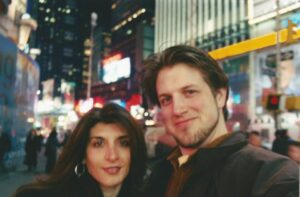
Dr. Christensen during his New Jersey year with his friend, Jennifer Conte, on Broadway, just off Times Square, surrounded by an artificial environment buzzing with real, human life.
Did it matter? I think it did. As someone who loves gardening, I appreciate the connection with another living organism. I relate to the struggle and growth. If a flower thrives it brings me joy. If it dies, I feel some sadness. The sun and the rain cause real flowers to grow; they cause artificial flowers to fade. The artificial flowers provide a lazy splash of color that becomes ragged and less vivid after a season outside in the elements.
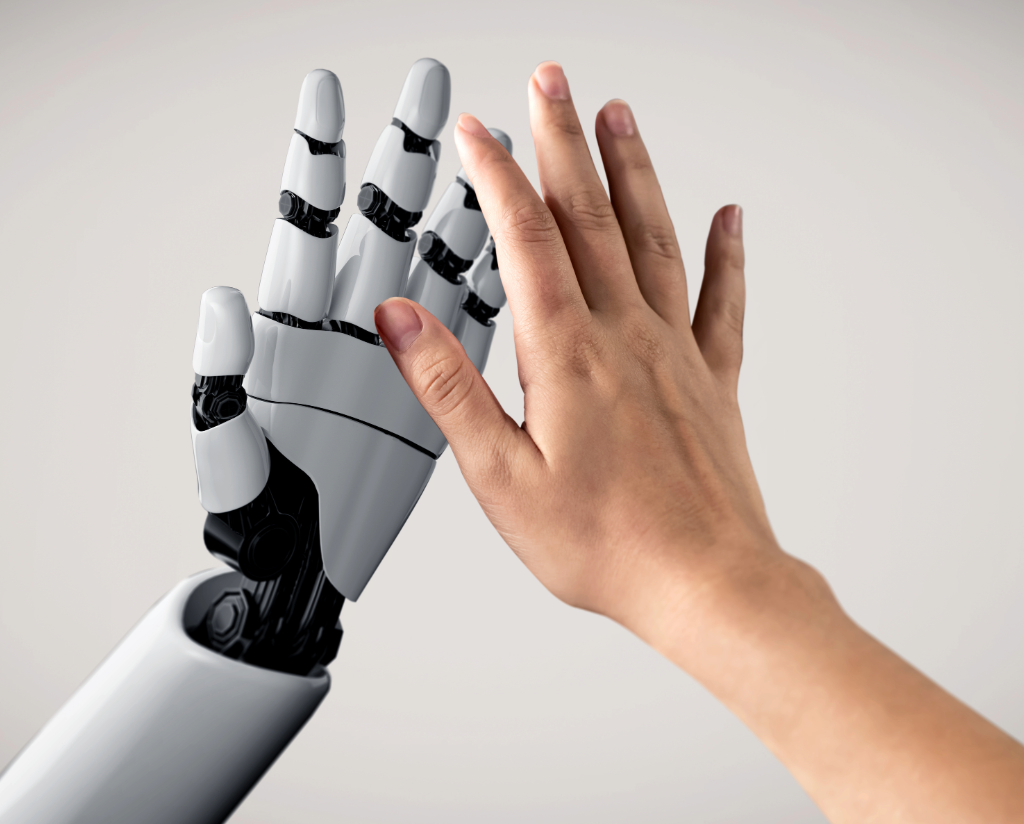
Back when I lived in New Jersey, most references to “AI” were understood only by people in my field of theriogenology or those struggling with their own fertility because it meant “artificial insemination.” Nowadays, of course, everyone understands “AI” as “artificial intelligence.” I recently heard on the news that the richest, most valuable company in the world, worth a market capitalization of over $5 trillion, is a company that makes the chips needed for AI technology. In less than a decade, AI has gone from mostly the stuff of science fiction stories to almost universally pervasive in our lives. Many of us snuff at it and express concern or distain, but then we turn around and use it in some forms throughout our days. Artificial intelligence is not anywhere near the same as natural intelligence. Something about it often feels “off.” But it is so convenient. Artificial intelligence relieves the user from using their own intelligence. No watering. No weeding. Instant results. Even if those results often feel somewhat “off.”
By some metrics, an AI-generated country song, “Walk my Walk,” reached the top of the charts. Country is known for its soulful, grassroots connections to “real” Americans. This song, ironically, is about surviving and thriving despite a tough life and being proud of the person you’ve become, having experienced all that you have. A non-human algorithm wrote that song about being proud of your human experience. It feels more than wrong, but wickedly subversive with not just a touch of ominous irony.
A physician and I were comparing our jobs recently and she admonished me to use ChatGPT to write my presentations and blogs, as she did. I was offended. I guess a bit pridefully I felt that my intelligence, experience, opinions, and personality were what people were paying for when they asked me to speak to their groups and what my clients were expecting when they read my blog. An AI-generated presentation would likely be more comprehensive, but would it be a better product? I mean, maybe it would?
We use AI in our hospital. Most notably, we use it to transcribe and edit the text of our examinations, and we use it to analyze radiographs and ECGs. I love these tools and I think that our service to our patients and clients is markedly better now that my medical records are more comprehensive, our radiographic interpretations are more sensitive and timely, and we are able to inexpensively evaluate every patient’s heart before inducing anesthesia. Most importantly, we humans are the ones directing the content; the AI is just interpreting and transcribing, not inventing and dictating.
The tools are not yet perfect and still require human oversight. Our transcription tool has mistakenly recorded that a couple of our patients are on cocaine (we have no idea what was said to make that error!). And recently it recorded that a male dog presenting for semen evaluation “did not like hand jobs” (in fairness, this was actually said by the client about the dog, but we felt it did not need to be recorded in the medical record…at least not in those words). We are careful to read all the transcriptions for accuracy before finalizing them, but there is no question that the AI-generated record contains much more comprehensive information than if we just try to remember what was said after the fact and type it in.
FDA approval of the use of AI in interpreting radiographs and ECGs is based off comparisons of thousands of patient studies showing that AI meets or exceeds human experts in accurately detecting disease conditions. Any source you read will tell you that AI in these instances is meant to augment, not replace, human interpretations, but I predict it is a matter of time, and short time at that, before humans are all but replaced in these areas of medicine. My nephew is currently in medical school and his mom, my sister, is a nurse. She warned him to steer entirely clear of radiology as a career path. I suspect she is right.
A large portion (30-40%) of our new clients come from internet searches. Whether or not a potential client is steered towards our website when searching for veterinary or reproductive services is based off a complicated algorithm I can’t even begin to understand. I hire a marketing company to help me with online advertising and to build and keep our webpage competitive and relevant. I work hard to make sure our webpage has complete, reliable, accurate information reflecting the fact that we are the only veterinarians in all of Northern California who are board-certified fertility specialists with expertise in canine reproduction. Despite these truths, expenses, and efforts, there is another veterinary practice in the Sacramento area that recently started coming up higher in online searches like “canine reproductive services near me.” And it’s not one of the veterinary practices any of you are probably thinking of. I had never heard of any breeders using them. I visited their webpage and found that they had a whole section of AI-generated content about canine reproduction. They claim to offer semen collection & freezing, vaginal cytology, progesterone assays, pregnancy ultrasound, and c-sections. There is no mention of foundational services like TCI, gestational aging, fertility evaluations, or neonatal care. Amazingly, they claim to offer coordination for embryo transfer referrals, which is a technique no one performs in dogs at the current time and is unlikely to ever catch on for canine breeding. Curious, I called to ask about their services and found out that in actual fact they offer NO reproductive services at all. The business owner has thousands and thousands of Facebook friends and I began to notice him popping us as a “mutual friend” for many of my Facebook contacts. Their website and social media are merely AI-generated SEO traps to attract new clients.
In the end, this business will not do any harm to our services since anyone who follows through on their online search and calls them will quickly figure out that it is all an AI-generated façade. It illustrates how AI technology can be faulty and can be manipulated.
Alexa and Siri have become increasingly convincing in their tone and cadence and skills. Undoubtedly AI will improve and become more “human” over time in its presentation and more accurate in its information. Will literature and art and medicine and architecture and city planning and political decisions yield more and more to AI technology? Where will it stop? What is left? What aspects of our human lives are improved and made safer by allowing AI to take over? What aspects of our lives need to retain a human origin? Are there aspects of medicine that need to retain a human origin? Or am I just being prideful and narcissistic? There is no question that, as a human, I make errors of both omission and commission. And eventually, perhaps, (for sure?), AI technology may become advanced enough to do a better job than me at diagnosing and treating clinical cases. It’s not there yet; our clients who rely on “Dr. Google” usually end up with poor advice and poor results. But I suspect it is only a matter of time, and short time, at that.
Our world is changing rapidly. The dehumanizing aspect of it is having an effect. I feel this is true even at seemingly innocent levels, like checking myself out at the grocery store instead of waiting a bit longer in line and interacting with my neighborhood grocery cashier and bagger. Mental illness is at an all-time high and experts think there is a strong tie to our increasing isolation from other humans and our natural environment.
I encourage everyone to seek opportunities to connect with other living, natural beings, human, animal, and plant. Your experience at Kokopelli Veterinary Center has been designed to support these connections from your entrance through our serenity garden with its native California plants, bird feeders, fishpond, and pollinator, bat, and bird houses to entering the reception area surrounded by live plants, beautiful fish, friendly humans, and art inspired by the human/animal bond. Your visit is overseen by caring, experienced, human staff and doctors who organically share and understand your personal, living connection to the animals in your family. We value, celebrate, and support the human/animal bond and the concept of One Health, that human, animal, and environmental health are intimately connected. That’s as real as it gets.